

Time Surfing: Experience History.

Historical Backdrop
In 1873, the low mound called Hisarlık, five kilometers inland from the Dardanelles in Ottoman Turkey, was being torn apart by a wealthy German merchant named Heinrich Schliemann. He had made a fortune in indigo, banking, and Crimean War contracts, then retired at 47 to prove that Homer’s Iliad described real places. Frank Calvert, an English-born consular agent who owned half the mound, had told him where to dig. Schliemann drove a giant trench straight down through nine buried cities, employing up to 150 Greek and Turkish villagers under an Ottoman permit that required him to split every find with the Imperial Museum in Constantinople.
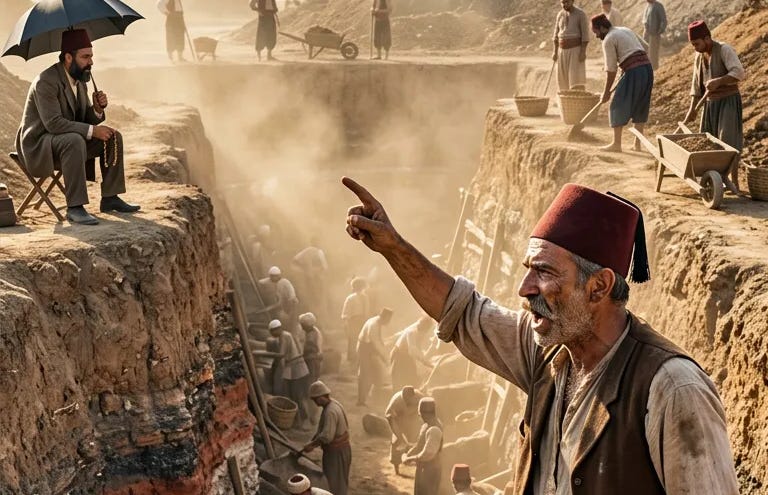
Our subject is Nikolaos Zaphyros Yannakis, a Greek Ottoman — once Calvert’s servant, now Schliemann’s foreman, cashier, interpreter, and fixer. He hired the men, paid them in copper piastres, translated between three languages, and knew exactly which Ottoman officials could be flattered and which had to be avoided.
Date/time and location: 31 May 1873, 4:20 a.m. — the wooden expedition house on the northwest lip of the Hisarlık mound, the Troad, Ottoman Empire
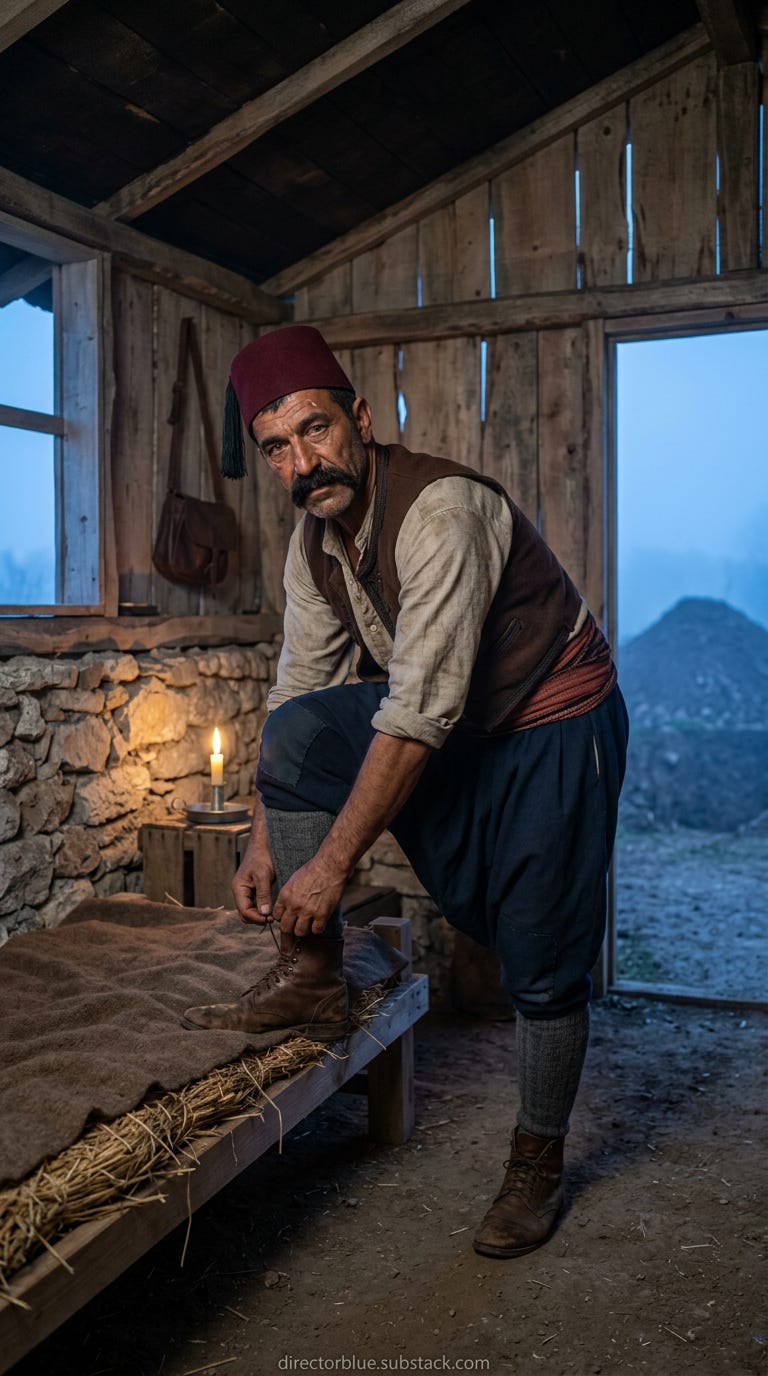
You wake before the light, on a plank cot in a shed of stone and unseasoned pine. Fleas have been at your ankles all night. The north wind comes through the gaps in the boards and rattles the oilcloth over the window. You hear the German already awake in the next room — pacing, coughing, dictating to himself in three languages. You pull on your boots without washing. Outside, the air smells of cold ash, donkey dung, and thyme. Below you, the Plain of Troy is a gray sea of mist with the Hellespont behind it.
Date/time and location: 31 May 1873, 5:05 a.m. — the eastern slope of the mound, muster ground beside the tool shed
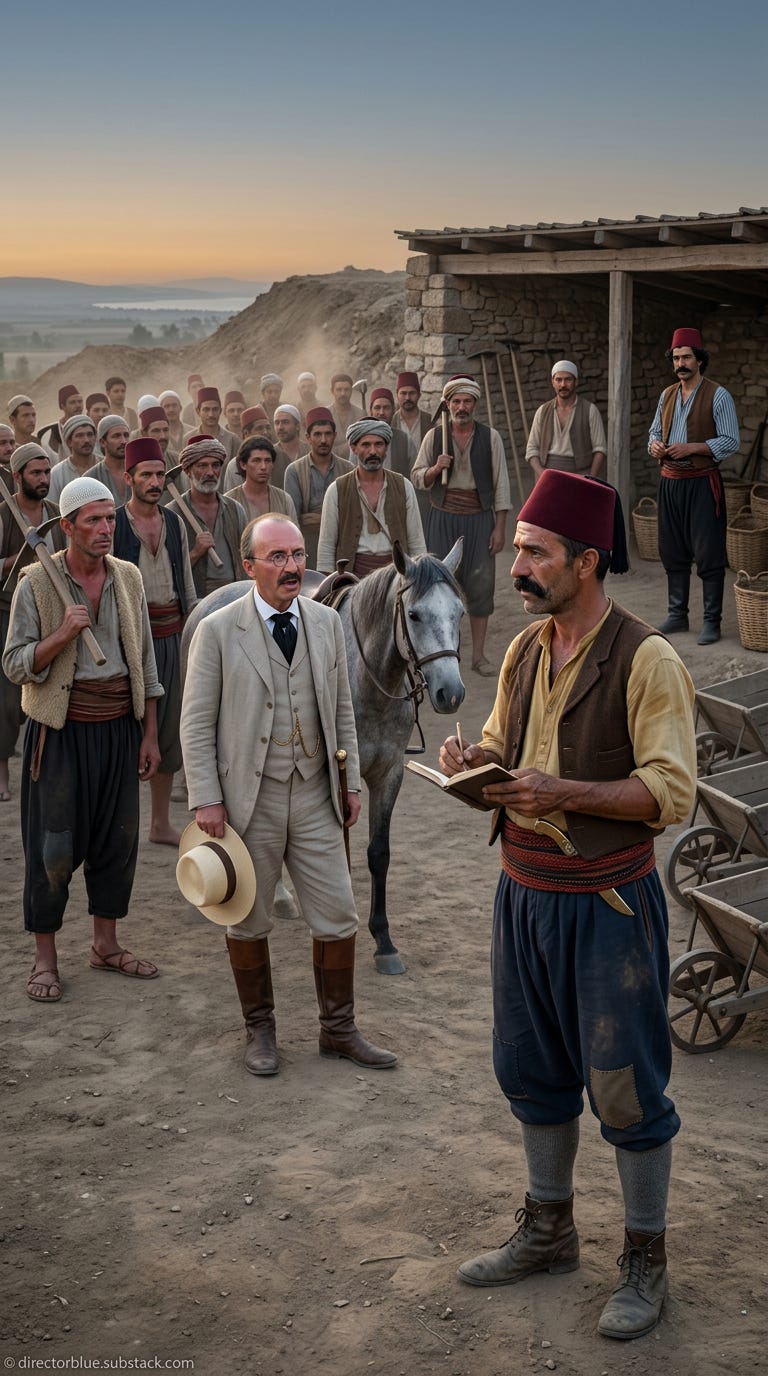
The men come up in the half-dark from Çıplak, Kalifatli, and Renkoi — Greeks and Turks, 120 of them, some still chewing bread. You call the roll from your tally-book and mark each name with a stub of pencil. The tool shed is opened. Iron picks, English spades, seventy-odd wheelbarrows with squealing wheels. Two men argue over a broken barrow handle and you settle it with a word. The other foreman, Photidas, counts out the baskets. Schliemann arrives on his gray horse from his sea bath, hair still wet, and starts giving orders before he dismounts.
Date/time and location: 31 May 1873, 6:30 a.m. — the Great Trench, cut north–south through the heart of the mound
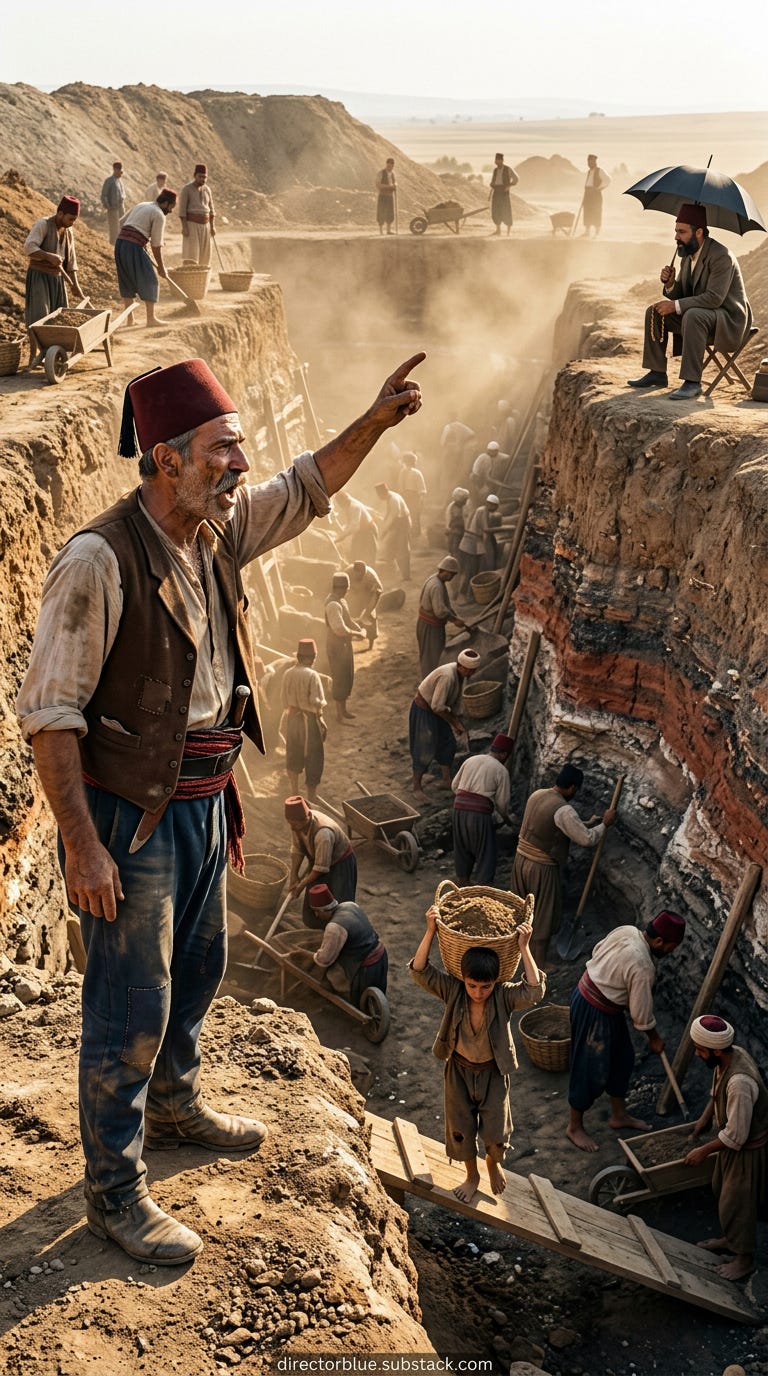
You stand on the lip of a gash forty feet deep and seventy wide. Down there the men work in three stages, one gang loading, one wheeling, one tipping over the edge. Dust rises in a solid brown column and the north wind carries it into your teeth. Pick-iron rings on stone. A boy of eleven runs a basket of earth up a plank ramp on his shoulder, barefoot. Below, burnt layers show in the section like bands in a cake — red, black, ash-white. Amin Effendi, the government man, sits on a camp stool with his umbrella up, watching you all.
Date/time and location: 31 May 1873, 7:40 a.m. — the deep cut beside the great wall Schliemann calls the Scaean Gate
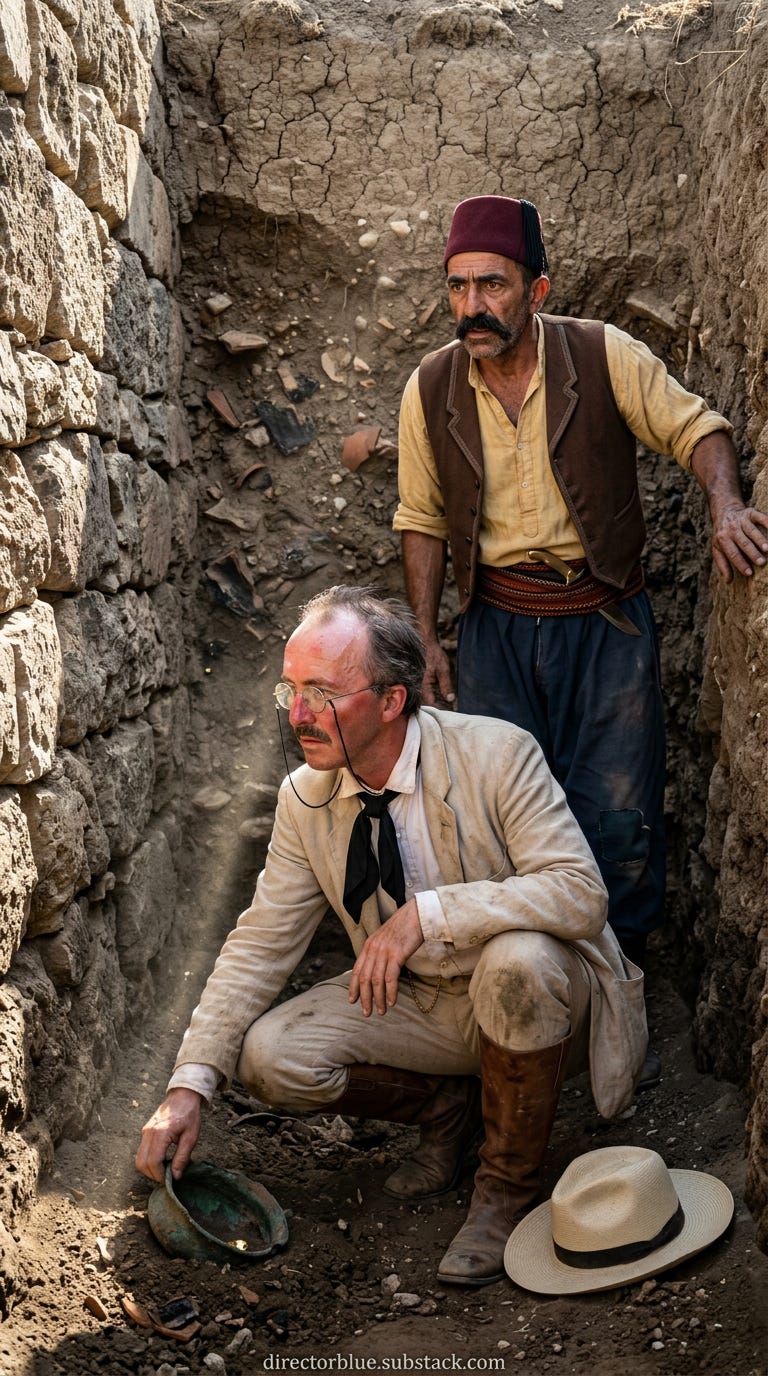
He calls you over. He is crouched at the base of a massive stone wall, in a slot where the earth overhangs nearly thirty feet above his head. The face of the cut is dry and crumbling and small stones tick down constantly. He is scraping with his hand at something dull and green in the dirt — copper, you think. Then, behind the copper, a yellow gleam that is not copper. He goes very still. He looks up at you, and his eyes behind the spectacles are wet. He says one word: Gold. Then, quietly: get the men away.
Date/time and location: 31 May 1873, 8:00 a.m. — the trench edge above the great wall
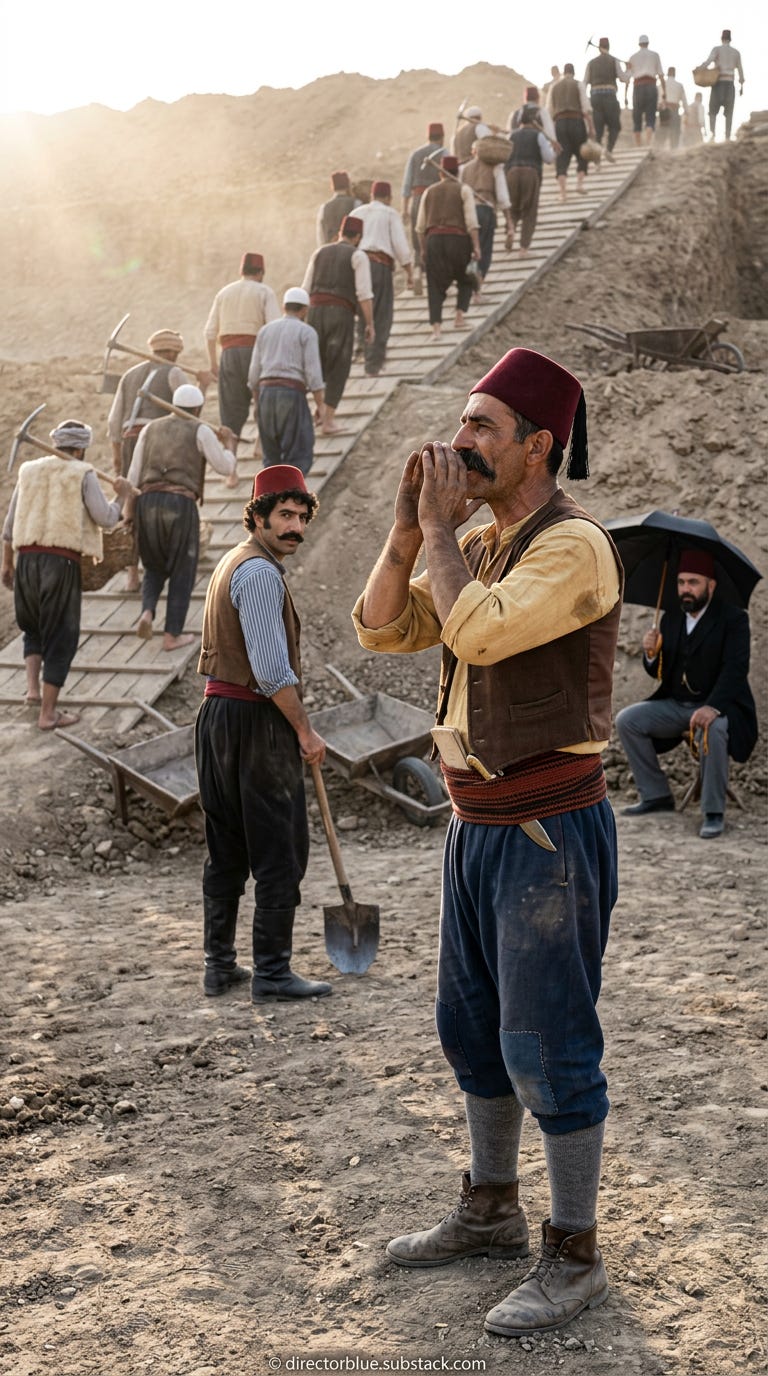
You climb out and cup your hands and shout the word every man on the hill loves: Paidos! Break. Two hours early. They look at you like you are mad, then they drop their picks and go, laughing, up the ramps toward the shade of the spoil banks and their bread and olives. Photidas asks why. You tell him the master has a headache and wants quiet. Amin Effendi’s head comes up under his umbrella. You feel your pulse in your neck. You send two men to fetch water from the far well, the slow way, and you keep your face flat.
Date/time and location: 31 May 1873, 8:20 a.m. — the slot beneath the overhanging earth face
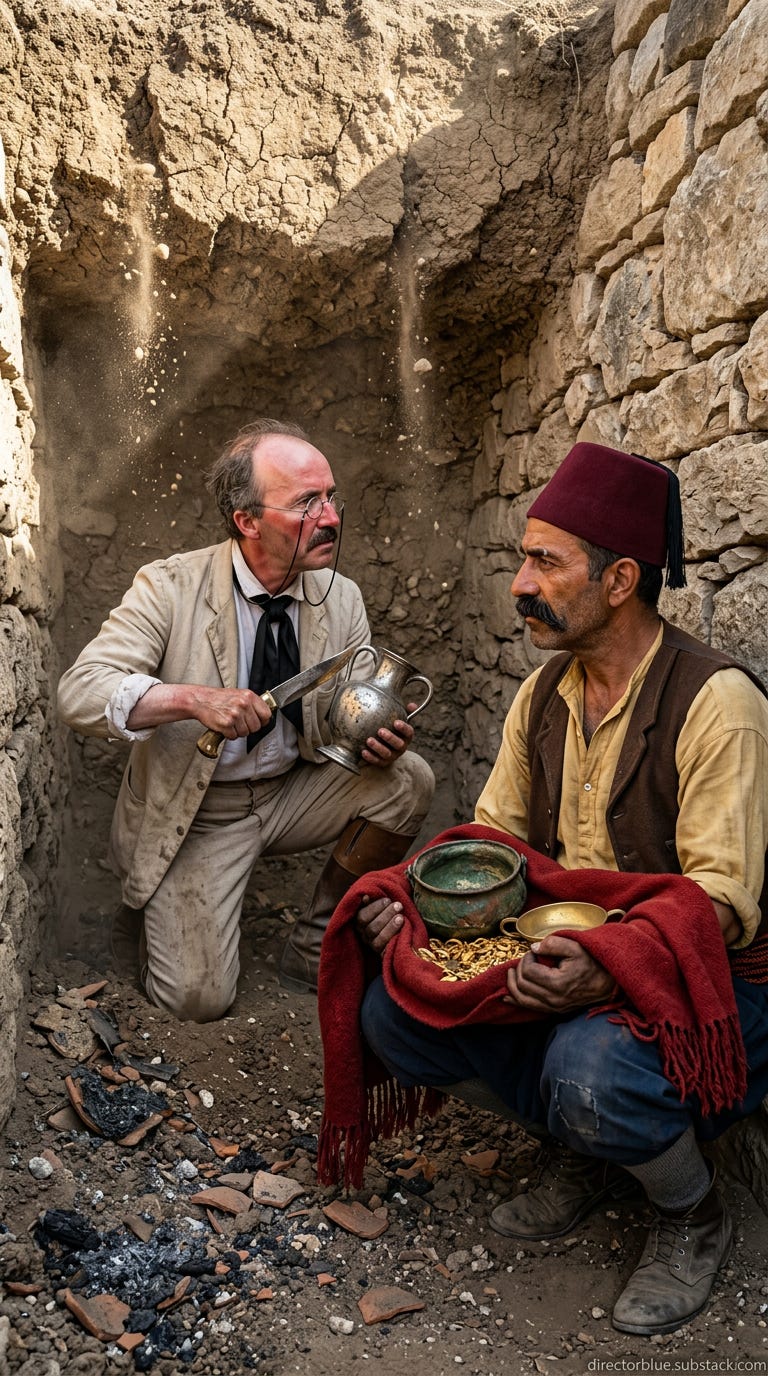
He works with a large clasp knife, on his knees, cutting the objects out of the packed earth one at a time. The wall of dirt above him groans and sheds. You crouch at the mouth of the hole with the big red shawl spread across your arms and take what he passes back — a copper cauldron, a silver jar heavy as a lamb, a flat gold cup, cold in the sun. Then a mass of gold chains and leaves that pours through your fingers like water. Your hands shake. The knife blade snaps. He keeps cutting with the stub.
Date/time and location: 31 May 1873, 8:55 a.m. — the path from the trench to the expedition house
