


In an interview on August 12, 2025, with Sid Rosenberg on "Sid and Friends in the Morning," Secretary of State Marco Rubio confirmed that the administration is "in the works" on designating the Muslim Brotherhood as a terrorist organization.

What’s the background of this statement?
The Muslim Brotherhood frequently made headlines during the Obama administration, whether because of its brief takeover of the Egyptian government, its invitation to the White House, or its shadowy ties to longtime Hillary Clinton aide Huma Abedin.
The U.S. advocacy group called CAIR (the Council for American-Islamic Relations) appears closely tied to the Muslim Brotherhood:
CAIR's co-founders, such as Nihad Awad and Omar Ahmad, were previously involved with the Islamic Association for Palestine (IAP), described in court documents as a propaganda arm for Hamas, which itself originated as the Palestinian arm of the Muslim Brotherhood.
A 1991 internal Muslim Brotherhood memorandum, uncovered during FBI investigations, outlined a strategy for "civilizational jihad" in North America and listed organizations like the IAP as part of its network.
In the 2007-2008 Holy Land Foundation (HLF) trial—the largest terrorism-financing case in U.S. history—CAIR was named an unindicted co-conspirator, with evidence showing its leaders attended a 1993 meeting in Philadelphia where participants discussed supporting Hamas and countering the Oslo Accords.
The HLF was convicted of funneling millions to Hamas, and CAIR's inclusion led the FBI to sever formal outreach ties with the group in 2008, citing its "established" links to Hamas.
But what is The Muslim Brotherhood?
Throughout his presidency, Barack Obama refused to use the word "terror", let alone "Islamic terrorism", when it comes to describing the unceasing series of attacks launched at the behest of a fanatical ideology.

In October 2005 President George W. Bush used the term “Islamic fascist” for the first time to describe the Muslim barbarians at war with the West. He denounced them as movements that have a “violent and political vision”, and call for “the establishment... of a totalitarian empire that denies all political and religious freedom.”
The Muslim groups which today seek to bring about a global totalitarian empire are not only fascists, but can trace their origins to Nazism and its genocidal ambitions.

The ideology of the Islamists whose ranks today include not only al-Qaeda but also Hamas and Hezbollah -- originated with Egypt’s Muslim Brotherhood. And the Muslim Brotherhood finds not just its roots, but much of its symbolism, terminology, and common cause deep within the origins of Nazism.

Hassan al-Banna (1906 - 1949) was born into the family of a poor watchmaker in southern Egypt.
As a child, he was attracted to the extremist aspects of Islam, which were hostile to Western secularism and to its system of rights, particularly women's rights.

While still in his teens, the young al-Banna and friends (they referred to each other as ‘brethren’) met frequently to discuss the situation in the Middle East, to argue about the ills of Arab society, and to lament the decline of Islam. Their angst was in large part a reaction to the collapse of the Ottoman Empire, the end of the Muslim Caliphate, the British occupation of Egypt, and the resulting exposure of Arab society to Western values.

In order to strike back against these evils, al-Banna founded the Muslim Brotherhood in 1928. Among the perspectives he drew on to address these issues were the anti-capitalist doctrines of European Marxism and especially fascism.

The group expanded during the 1930’s as Al-Banna would describe, in inflammatory speeches, the horrors of hell expected for heretics, and consequently, the need for Muslims to return to their purest religious roots, re-establish the Caliphate, and resume the great and final holy war, or jihad, against the non-Muslim world.

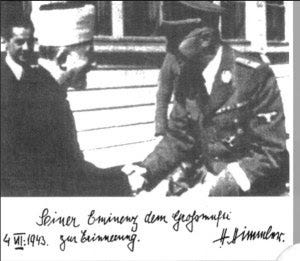
The first big step on the path to the international jihad came during “The Great Arab Revolt” of 1936-9, when one of the most famous of the Muslim Brotherhood’s leaders, the Hajj Amin al-Husseini, Grand Mufti (Supreme Muslim religious leader) of Jerusalem, incited his followers to a three-year war against the Jews in Palestine and the British who administered the Mandate.
By the end of the 1930’s there were more than a half million active members registered, in more than two thousand branches across the Arab world.

It was during this time that the Muslim Brotherhood found a soul mate in Nazi Germany.
The Reich offered great power connections to the movement, but the relationship brokered by the Brotherhood was more than a marriage of convenience. Long before the war, al-Banna had developed an Islamic religious ideology which previewed Hitler’s Nazism. Both movements sought world conquest and domination.
Both were explicitly anti-nationalist in the sense that they believed in the liquidation of the nation-state in favor of a trans-national unifying community: in Islam the umma (community of all believers); and in Nazism the herrenvolk (master race). Both worshipped the unifying totalitarian figure of the Caliph or Führer.